The Most Cost-Effective Guide to Decentralized Sewage Treatment for Small Parks/Factories
For small industrial parks, manufacturing factories, or eco-parks with limited space, budget constraints, and relatively small sewage discharge, decentralized sewage treatment systems have emerged as the optimal solution. Unlike centralized treatment that requires complex pipeline networks and large-scale facilities, decentralized treatment realizes on-site collection, treatment, and reuse (or up-to-standard discharge) of sewage, balancing treatment efficiency, investment cost, and operational convenience. This guide will break down how small parks and factories can select, design, and operate decentralized sewage treatment systems to maximize cost performance.
1. Why Decentralized Treatment Is the First Choice for Small Parks/Factories
Before diving into cost-effective solutions, it’s essential to understand why decentralized treatment outperforms centralized treatment for small-scale users:
- Lower Initial Investment: Centralized treatment requires laying long-distance sewage pipelines to connect all discharge points to a central treatment plant, which accounts for 30%-50% of the total investment. Decentralized systems are built near sewage sources, eliminating the need for extensive pipeline networks and significantly reducing initial construction costs.
- Flexible Scalability: Small parks and factories often have phased construction plans or fluctuating sewage discharge. Decentralized systems can be expanded modularly—adding treatment units as production scales up—avoiding the waste of over-investment in early-stage large-scale facilities.
- Energy and Operational Cost Savings: On-site treatment reduces the energy consumption of long-distance sewage transportation. Meanwhile, compact decentralized equipment has simpler operation logic, requiring only 1-2 professional operators (or part-time management), lowering labor costs compared to centralized plants that need a full operational team.
- Strong Adaptability to Water Quality: Small factories (such as food processing, mechanical parts cleaning) may have intermittent or variable sewage water quality. Decentralized systems can be customized to target specific pollutants (e.g., organic matter, suspended solids, oil) with adjusted processes, ensuring stable treatment effects that meet discharge standards.
2. Key Principles for Selecting Cost-Effective Decentralized Systems
The core of cost performance lies in "matching needs without overcapacity." Small parks/factories should follow these principles when selecting systems:
2.1 Prioritize Process Matching Based on Water Quality and Quantity
The first step is to conduct a comprehensive survey of sewage discharge: including daily discharge volume (usually 50-500 m³/d for small users), peak discharge, water quality indicators (COD, BOD₅, SS, NH₃-N, pH, etc.), and discharge requirements (local environmental standards or reuse needs). Overlooking this step may lead to selecting an overcomplicated or undersized system, increasing costs or failing to meet standards.
For example: If the sewage is mainly domestic sewage from park dormitories or low-concentration organic sewage from light industry (COD < 500 mg/L, BOD₅/COD > 0.3), low-cost biological processes such as Sequencing Batch Reactors (SBR), Moving Bed Biofilm Reactors (MBBR), or Anaerobic Baffled Reactors (ABR) are preferred. These processes have mature technology, low operational costs, and high pollutant removal rates (COD removal rate up to 85%-95%).
If the sewage contains oil (e.g., mechanical processing factories) or refractory pollutants, a pre-treatment unit (oil separator, coagulation sedimentation tank) should be added before the biological process, avoiding direct use of high-cost advanced oxidation processes (AOPs) unless mandatory by discharge standards.
2.2 Choose Modular and Integrated Equipment
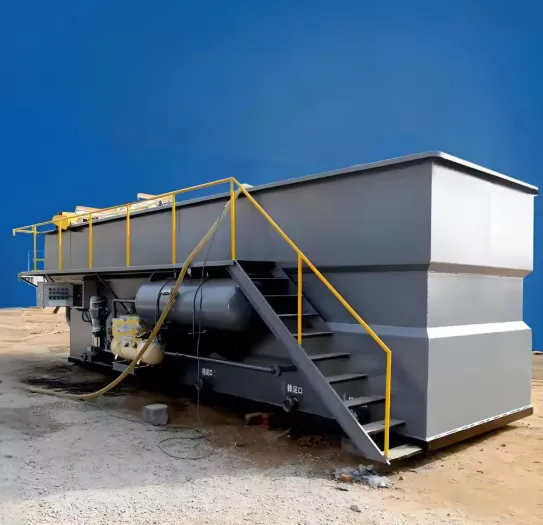
For small sites, integrated decentralized equipment (combining pre-treatment, biological treatment, and advanced treatment in one unit) is more cost-effective than split-type facilities. These devices have the advantages of compact structure, small footprint (saving land use costs), quick installation (shortening construction cycles to 1-2 months), and standardized production (lowering equipment manufacturing costs).
Modular design also allows for flexible combination. For example, when sewage discharge increases from 100 m³/d to 200 m³/d, you only need to add a same-type module instead of rebuilding the entire system, reducing expansion costs by 40%-60% compared to centralized treatment.
2.3 Balance Operational Costs and Long-Term Maintenance
Initial investment is only one part of the total cost; operational costs (energy, chemicals, labor) and maintenance costs (equipment replacement, repairs) account for 60%-70% of the total cost over the system’s lifespan (usually 10-15 years). Therefore, cost performance cannot be judged solely by the initial price.
When selecting equipment, pay attention to: ① Energy efficiency: Choose low-power aerators, pumps, and other equipment (energy consumption accounts for 30%-40% of operational costs); ② Chemical dosage: Biological processes with low chemical demand (e.g., MBBR) are better than chemical treatment processes; ③ Maintenance difficulty: Select equipment with mature spare parts and simple maintenance (e.g., equipment with detachable components), avoiding specialized maintenance that incurs high costs.
3. Cost-Saving Tips in Design and Operation
3.1 Optimize On-Site Layout to Reduce Pipeline Costs
Arrange the treatment equipment as close as possible to the main sewage discharge points (e.g., factory workshops, park restaurants) to shorten the length of on-site collection pipelines. Use gravity flow design where possible to reduce the need for lifting pumps, saving energy consumption and equipment investment.
3.2 Promote Sewage Reuse to Improve Economic Benefits
Treated reclaimed water can be used for greening irrigation, road cleaning, equipment cooling, and flushing in small parks/factories, reducing the demand for tap water and lowering water purchase costs. For example, a 100 m³/d decentralized system can save about 36,500 m³ of tap water per year, creating direct economic benefits of 100,000-200,000 yuan (depending on local water prices).
3.3 Strengthen Daily Management to Extend Equipment Lifespan
Regular maintenance (e.g., cleaning filters, checking aerators, testing water quality) can extend the equipment lifespan by 2-3 years and avoid unexpected failures that cause high repair costs and production shutdowns. Establish a simple operational log to record water quality, chemical dosage, and equipment operation status, enabling timely adjustment of operational parameters to optimize treatment efficiency and reduce costs.
4. Common Misunderstandings to Avoid
- Misunderstanding 1: Pursuing "High-End" Processes Blindly: Some users believe that advanced processes mean better treatment effects, but for small-scale low-concentration sewage, ordinary biological processes can meet standards, and advanced processes will only increase initial investment and operational costs.
- Misunderstanding 2: Ignoring Local Environmental Standards: Before designing the system, confirm the local discharge standards (e.g., national Class A or B standards for surface water, or reuse standards). Under-designing will lead to non-compliance and fines, while over-designing will waste costs.
- Misunderstanding 3: Neglecting After-Sales Service: Low-cost equipment may lack perfect after-sales service. Once a failure occurs, it may take a long time to repair, affecting normal production and treatment. Choosing manufacturers with local after-sales outlets and timely technical support is crucial for long-term cost savings.
Conclusion
For small parks and factories, the most cost-effective decentralized sewage treatment solution is not about choosing the cheapest equipment, but about achieving a balance between "meeting discharge/reuse needs," "controlling initial investment," and "reducing long-term operational costs." By conducting in-depth water quality surveys, selecting matching processes and modular equipment, and optimizing daily operation and maintenance, small users can realize efficient, economical, and environmentally friendly sewage treatment, laying a solid foundation for sustainable development.